
Nature, Animism, and Agency
— what if humans are not at the top of the species pyramid?
Translated from Danish:
Natur, animisme og agens. Tænk hvis mennesket ikke er toppen af artspyramiden?
There is a story that feeds the continued worsening of the climate crisis, the ongoing impoverishment of nature, and the continued extinction of hundreds of thousands of species. It is a story that decision-makers retell to one another, and that our culturally determined concepts and overconsumption tend to reaffirm.
It is a narrative that casts the human as the pinnacle of the species pyramid, surrounded by an unconscious nature. It is the story of humanity’s monopoly on agency. But is it a good story? Is it a story that has benefited the world?
There are other stories, too.
What if consciousness is not contained and enclosed within human heads? What if consciousness is not distanced from nature, and agency is not a human monopoly? Perhaps we humans would act differently within such a story.
What if other species, landscapes, and things can also have agency — not like you and me, but not not like us? This is the cross-cultural narrative we call animism, whose relevance is also reflected in contemporary thought.
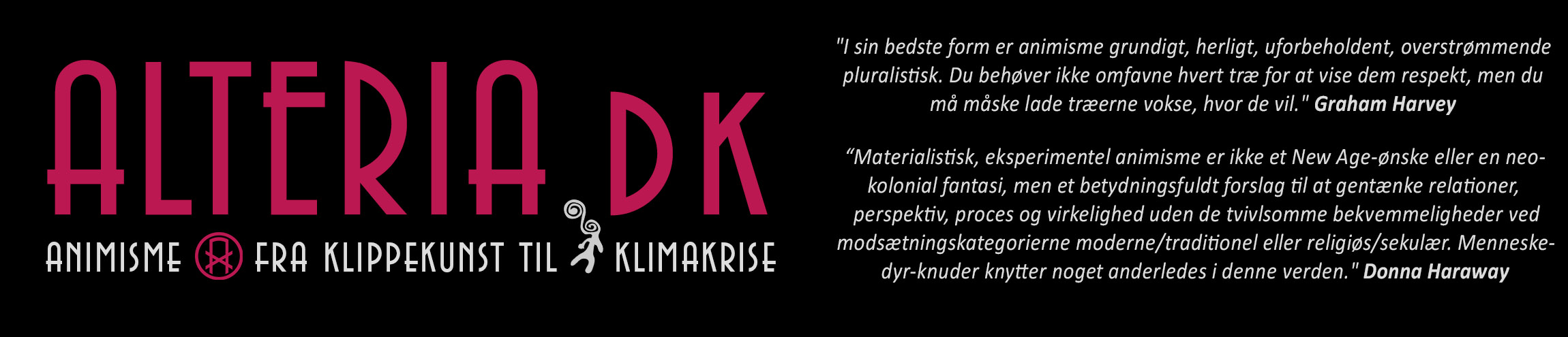
Not as “a New Age wish nor a neocolonial fantasy,” as, for example, the historian of science Donna Haraway writes in Staying with the Trouble, but as a confrontation with the destructive relationship between the human and the non-human. Haraway “reinterprets and twists” the dominant distancing narrative of humanity’s monopoly on agency and looks toward animism, which is precisely a story of “twisted” forms of knowledge, where both the human and the non-human can possess agency and personhood.
For is it not the dominant narrative of nature’s unconsciousness that motivates the lack of scruples with which we homogenize nature, wipe out species, and torment millions of production animals?
Perhaps, conversely, the paradoxical animist narrative motivates conscientious and respectful relationships with the species we live with and off, because it acknowledges nature’s agency and personhood — not as a one-sided counter-narrative to the rational one, but as a co-narrative that supplements it.
And what if that story seems more paradoxical, but is, in return, less mad than the dominant narrative about taking and taking until there is nothing left to take from a friendless and apparantly unconscious nature?
Maybe we would not act more headlong, but less heartlessly, in a world where agency is more than human. Maybe we would learn to respect other peoples’ forms of knowledge as supplements to our own, without romanticizing theirs or idealizing ours. Maybe we would become better at relinquishing space and privileges to nature’s wild unfolding.
These are many maybes. But maybe the gravity of our time’s biodiversity and climate crises calls for other stories than the story of human supremacy and overconsumption?
Rune Engelbreth Larsen, Danish historian of ideas
Published in the Danish daily ‘Information’ online and on print (January 22. and 23., 2026)
• Also in English: Why the animist Raven flag might be relevant again
• Three videos in English: